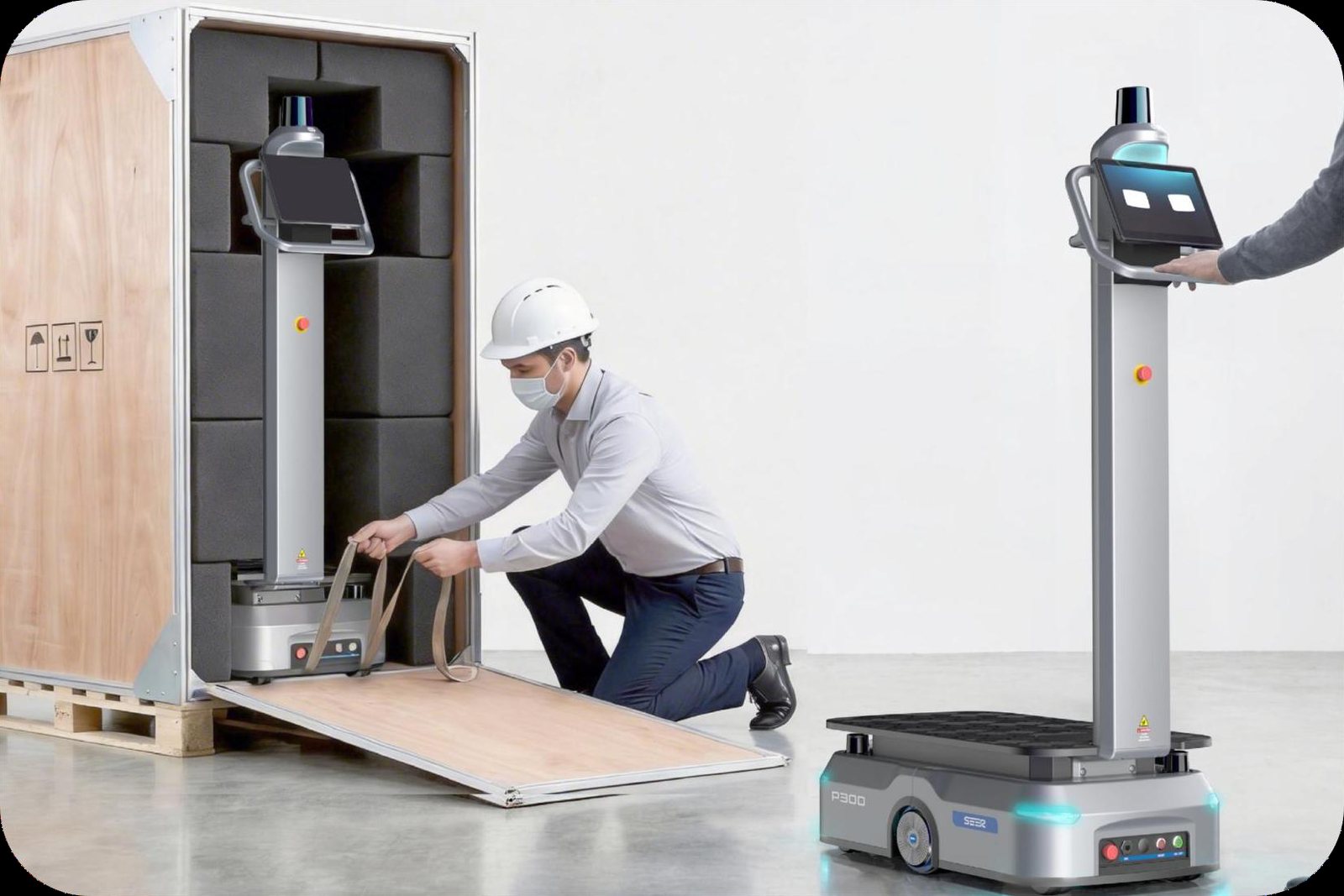
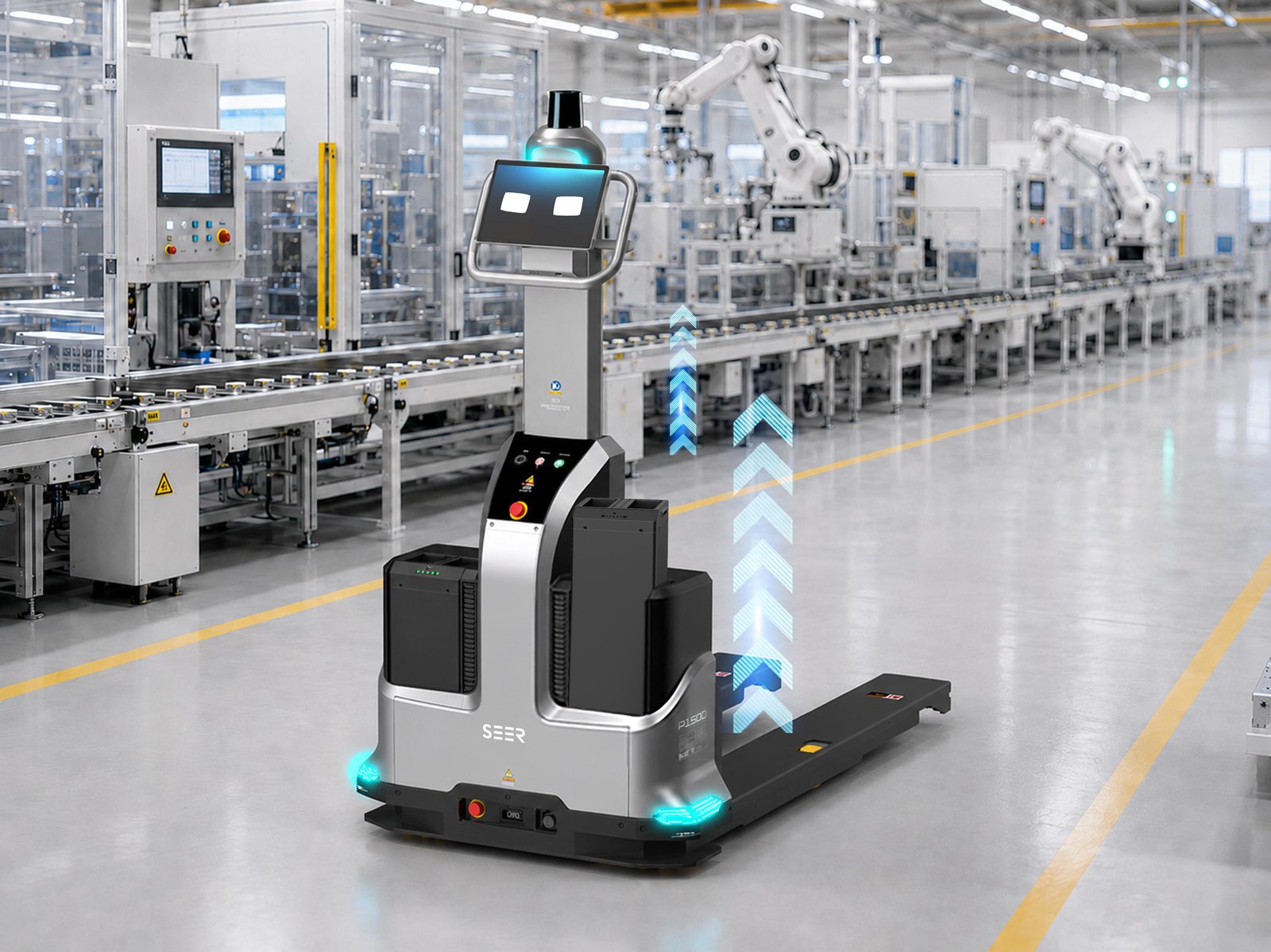
Answers come from SEER’s published specifications for P300 and P1500. Final configuration, aisle measurements and service terms are confirmed in the survey and the quotation.
01Do I have to change the floor to run it?
No. Navigation is laser SLAM: the robot builds its own map on the first run, with no tape, magnets or reflectors to install. Site work is a charger position and a network drop, not a rebuild.
02How narrow an aisle can it work in?
P300 needs 580 mm minimum aisle and turns in a 988 mm diameter. P1500 needs 990 mm and 1,800 mm for right-angle stacking. Both are quoted for the robot alone; racking and pedestrian clearance still have to be measured on site.
03How much can each model carry?
P300 carries 300 kg with a 680 × 460 mm lift platform and 60 mm stroke. P1500 carries 1,500 kg on a stringer pallet, with fork outer width 600 or 680 mm and fork height 90–210 mm.
04How fast does it travel, and how accurately does it stop?
Up to 1.2 m/s on both models, with navigation accuracy of ±10 mm and ±0.5°. That is the figure that decides whether a docking station or a conveyor hand-off will align without a fixture.
05How long does deployment take?
SEER publishes about ten minutes from unboxing to a first delivered load in its standard scenario on a 200 m map. A production rollout is longer: the survey, map, charger and integration are project work, and a multi-robot fleet is scheduled rather than unboxed.
06What is the battery life, and how does charging work?
Both use 48 V LiFePO4 packs with about 8 hours of unladen endurance. Charging from 10% to 80% takes under an hour, automatically or manually. P300 packs are rated for 1,500+ cycles, P1500 for more than 2,000, and the P1500 battery swaps by hand in about 30 seconds.
07Can it handle ramps, thresholds and floor gaps?
P300 is rated for a 5% grade, a 5 mm step and a 30 mm gap. Anything outside that is a floor repair, not a robot setting, which is why floor condition is part of the survey.
08Can one robot cover more than one floor?
Yes, where the building allows it: lift, door, turnstile and access-control integration sit in the same map, so a route can include a lift call instead of one robot per floor.
09How large an area can it map?
Up to 400,000 m². In practice the constraint is normally network coverage and charger placement rather than the map limit.
10What environment is it rated for?
P300 is IP20, 0–50 °C and 10–90% RH non-condensing; P1500 is IP20 at ≤ 70 dB(A). Both are indoor machines; outdoor or wash-down areas need a different specification.
11How does it connect to our WMS or MES?
Tasks are issued by the WMS or MES to RDS, SEER’s dispatch platform, which assigns each job to a robot and plans the route. Integration is through open APIs and low-code workflow configuration, so the integrator wires the line rather than writing a driver per device.
12Can it run alongside our forklifts and other brands?
RDS coordinates AMRs, automatic forklifts, conveyors and doors under one schedule, including mixed-brand fleets. Manual forklifts are handled by the site’s traffic rules, which the survey reviews.
13What happens in narrow aisles with two-way traffic?
Intersections, single-lane segments and charging points are arbitrated in real time, so robots queue and yield instead of deadlocking. Where the aisle is physically too narrow for two-way flow, the layout or the traffic rule changes, not the robot.
14P300 or P1500 — how do we choose?
By load and by aisle. P300 is point-to-point, line-side and machine-side work up to 300 kg with a 580 mm aisle. P1500 is full-pallet work on stringer pallets, floor-stack rather than high-rack, needing 990 mm and 1,800 mm for right-angle stacking.
15What happens when the layout changes?
The map is updated and routes are re-planned. Because there is nothing embedded in the floor, moving a rack does not invalidate the installation the way a magnetic-tape or reflector layout would.
16What safety certification does it carry?
P1500 is listed with ISO 3691-4, EMC/ESD, UN38.3 and RoHS, and carries one navigation lidar plus four avoidance lidars and a camera. Configuration is confirmed per project against the site’s risk assessment.
17Does the site need Wi-Fi everywhere?
It needs coverage along the routes and at the charging points. Dead spots are found in the survey, so access-point placement is quoted as part of the project rather than discovered after the robots arrive.
18Who supports it after handover?
Pulselink carries one spare-parts path and one escalation route for both models, with the integrator or the site trained at commissioning. Response and service terms are written into the contract for the project.